Showing posts with label museums. Show all posts
Showing posts with label museums. Show all posts
Monday, February 2, 2009

Friday, August 1, 2008
And now for something completely discipline specific...
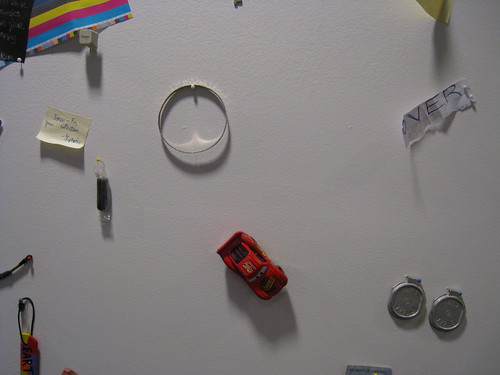
 Y'all know how I love art about museums or museum humor. The museum staff at SFMOMA recently hung their own artwork on 4 floors of the museum's offices in an exhibition titled ART : WORK. 25% of the staff participated, isn't that great?
 Above is the wall text from my favorite piece with a sample of the installation below. Brilliant! What would your office do? You can read more about the show on their blog Open Space and check out the pictures on their flickr stream.
Saturday, April 26, 2008
Wall Text for the Home
As demonstrated by my earlier post on wall text, I love to geek out on museum and curatorial type humor. I suspect that not too many people find these things funny, but I do know that it make me a huge dork. I recently pulled Steve Martin's book Pure Drivel off my bookshelf, which has several hysterical art related essays, and of course I also own the Museum of Bad Art's original collection handbook, now out of print. Is there something about springtime that makes one seek out humorous material (and blog about it)?
I recently stumbled across the below on McSweeney's, a site that I should visit more often, and found this witty take on wall text. Enjoy!
I recently stumbled across the below on McSweeney's, a site that I should visit more often, and found this witty take on wall text. Enjoy!
WALL TEXT FROM MY HOME. BY GRAHAM T. BECK
Read more wall text here.
- - - -
Brown Couch, 1999
UPHOLSTERY, WOOD, POLYESTER FILL, ASSORTED STAINS.
PERMANENT COLLECTION.
Undoubtedly one of Beck's best-known works, Brown Couch, 1999 was first shown at the Salvation Army in Poughkeepsie, New York, and has since been a centerpiece in all but one of his full-scale exhibitions.
Its distinctive form, created by the absence of one armrest, draws viewers in and allows sitters to choose between a chaise-longue position and a more conventional posture. Although it has received critical acclaim from all his tall friends, and is where Jack and Kate first made out, recent revisionist critiques by his girlfriend have focused on its threadbare cushions, which are stained on both sides.
------------------------------------------------------------
Jade Plant, 2006JADE PLANT, SOIL, TERRA-COTTA POT.
SEMI-PERMANENT COLLECTION.
Jade Plant, 2006 is the last surviving part of the Window Sill exhibition of the same year. Started as a way to showcase responsibility and give off an earthy, environmental vibe to his not yet live-in girlfriend, the vegetation-based display failed when he went away to New Mexico for three weeks and didn't ask anyone to water the plants.
Despite long periods of continued neglect, Jade Plant, 2006 has remained alive and mostly green. It frequently elicits the question
"Is that thing dead?"
Sunday, August 12, 2007
Next Stop Wonderland
Two artists (and a museum) that I featured in the PRC show Picture Show are in the Boston Globe today, and it's a great, wild ride of an article thanks to Greg Cook. Neil Salley, curator of Le Musée Patamécanique--think cabinet of curiosities meets new media museum--has a large spread and even a video (see the latter here). I can't wait to see what it looks like on paper! If it's possible to miss an exhibition after it's down, I sure miss this one! Here is a link to the piece I showed by Hans Spinnermen at the PRC (you can explore the flickr set to to see the whole PRC show).
I spoke to Greg at length on the phone about le Musée and other efforts, such as the Museum of Jurassic Technology. Here is my quote in the newspaper:
UPDATE: Greg Cook posted some excerpts from his conversation with Neil on the NEJAR blog. Great stuff!
Neil Salley and Hans Spinnermen's Earolin, From Boston Globe

I spoke to Greg at length on the phone about le Musée and other efforts, such as the Museum of Jurassic Technology. Here is my quote in the newspaper:
The Musée's website is packed with footnotes that purport to explain what's going on and the institution's historical underpinnings. Leslie Brown, a curator at Boston University's Photographic Resource Center who has exhibited one of Spinnermen's contraptions, says, "You cannot read some of the footnotes . . . and not laugh. I think one of the footnotes said, 'See Marcel Duchamp.' All of Duchamp. It's like saying, 'See Philosophy.'"Congrats Neil, Hans, and all of the patamechanics! A thanks goes to Greg, who is also at the helm of another another seemingly kindred institution, The New England Journal of Aesthetic Research.
UPDATE: Greg Cook posted some excerpts from his conversation with Neil on the NEJAR blog. Great stuff!
Neil Salley and Hans Spinnermen's Earolin, From Boston Globe

Wednesday, June 27, 2007
The Seldom Seen or Aberrant Photo
While in Rochester, we made the mandatory stop at the Eastman House and saw the Ansel Adams exhibition. This proved an interesting comparison with another collection-based exhibition from the Museum of Fine Art, Boston. The GEH offering was a wonderfully comprehensive exhibition that also included photographs taken in and around the University of Rochester, which I had never seen before. This grouping as well as "The Black Sun," a long exposure of landscape of a stream and tree, leads me to ponder the issues surrounding the seldom seen and the aberrant photograph - images that don't quite fit neatly into a series or haven't seen as much exposure.
Interestingly enough, an extensive internet search did not reveal an image of Adams's THE BLACK SUN, TUNGSTEN HILLS, OWENS VALLEY, CALIFORNIA, 1939/print ca. 1970. I could find a few references here and there in terms of solarization and Sabatier effects, but no image - not on GEH's online collections not Ansel Adams gallery's website and not on yahoo or google images. It seems this photograph is reproduced in his book, The Negative, likely as a teaching tool, but are such images deemed too aberrant to showcase online?
Over on his See, Hear, and Remember blog, Christian Patterson recently discussed the idea of "difference vs. sameness" within constructing a series and Shane Lavalette followed up with a post that garnered many comments and another on repetition. I'd like to take up another angle on this discussion: Is the aberrant image within a body of work or portfolio perhaps not one of intentional variety, but an issue of quality, editing, or maybe style, or rather, is it not understanding the role of this particular image at that particular time? Or, is it simply blind luck to capture something so disparate from one's style? (Is the latter even possible?) Further, are such images deemed unfitting by the photographer, the curator, the collector, or the museum, and thus put away and then overlooked? Are the images that are taken for a different reason or as an experiment, relegated to the metaphorical and physical shelf to be "discovered" later? Conversely, do such square pegs simply need to gestate, find their mates, and thus make sense later in one's life, oeuvre, or even decades later from the perspective of a third party? As a juror and reviewer, I must admit some guilt, as often I recommend that photographers build and submit a series that holds together in a juried situation. In such a quick fire method, straight-up aberrant images simply don't hold up and thus often result in the elimination of the whole series. This is not to say that an image cannot be different from others, it can and still fit, but it is the "fittingness" that is hard to explain and a definition of "style" not easy to teach or communicate. As an art historian, we often benefit from looking through the long lens of history when analyzing such groupings (or creating them?).
On the other hand, do such seldom seen images or those created for other purposes lead to new avenues and series? Do these transitional images sow the seeds of a later style shift or are simply accidents? Robin Kelsey, photohistorian at Harvard, gave us a sneak peak at his musings on photography and chance as well as art and accident at the Clark symposium and Boston's CAA respectively. I look forward to what hopes to be a pending book!
Interestingly enough, an extensive internet search did not reveal an image of Adams's THE BLACK SUN, TUNGSTEN HILLS, OWENS VALLEY, CALIFORNIA, 1939/print ca. 1970. I could find a few references here and there in terms of solarization and Sabatier effects, but no image - not on GEH's online collections not Ansel Adams gallery's website and not on yahoo or google images. It seems this photograph is reproduced in his book, The Negative, likely as a teaching tool, but are such images deemed too aberrant to showcase online?
Over on his See, Hear, and Remember blog, Christian Patterson recently discussed the idea of "difference vs. sameness" within constructing a series and Shane Lavalette followed up with a post that garnered many comments and another on repetition. I'd like to take up another angle on this discussion: Is the aberrant image within a body of work or portfolio perhaps not one of intentional variety, but an issue of quality, editing, or maybe style, or rather, is it not understanding the role of this particular image at that particular time? Or, is it simply blind luck to capture something so disparate from one's style? (Is the latter even possible?) Further, are such images deemed unfitting by the photographer, the curator, the collector, or the museum, and thus put away and then overlooked? Are the images that are taken for a different reason or as an experiment, relegated to the metaphorical and physical shelf to be "discovered" later? Conversely, do such square pegs simply need to gestate, find their mates, and thus make sense later in one's life, oeuvre, or even decades later from the perspective of a third party? As a juror and reviewer, I must admit some guilt, as often I recommend that photographers build and submit a series that holds together in a juried situation. In such a quick fire method, straight-up aberrant images simply don't hold up and thus often result in the elimination of the whole series. This is not to say that an image cannot be different from others, it can and still fit, but it is the "fittingness" that is hard to explain and a definition of "style" not easy to teach or communicate. As an art historian, we often benefit from looking through the long lens of history when analyzing such groupings (or creating them?).
On the other hand, do such seldom seen images or those created for other purposes lead to new avenues and series? Do these transitional images sow the seeds of a later style shift or are simply accidents? Robin Kelsey, photohistorian at Harvard, gave us a sneak peak at his musings on photography and chance as well as art and accident at the Clark symposium and Boston's CAA respectively. I look forward to what hopes to be a pending book!
Wednesday, June 20, 2007
Off to Rachacha, Land of Photo
My oh my! It's been a long time since I've written. I've been really concentrating on summer, or at least trying. Since my last post, I went to another wedding, explored the Cambridge arts festival, hiked around Mt. Misery (mentioned in Thoreau's writings), moved my car twice for street cleaning, and sat and then got dismissed from jury duty. Needing a little more head clearing, Bruce and I are now off to Rochester to visit friends and family. Interestingly enough, in the last few weeks, I've corresponded or met with 4 photographers that had ties to Rochester. Usually, it's through school, be it RIT or VSW, and at least 2 of them repeated the nickname above, Rachacha. I don't know where this epithet came from; I thought I was the only one who said it, but apparently not!
While in Rochester, we will go to the Keuka Lake winery Dr. Konstantin Frank, have a barbecue with friends, check out the Rochester Criterium (a fast-paced short bike race held downtown), pop in the Eastman House to see the Steichen autochromes, and maybe hit MassMoca on the way back to witness the Christoph Büchel spectacle/debacle. You can read the whole back story on the massive installation here, and read an archive of his demands here. When we were there last time, we could only see the theatre entrance and it was completely closed. Either way, neither no one wins in this situation. I am sure that it will fuel many dissertations for a long time to come.
Addendum: the real autochromes weren't on display, reproductions were. Although I understand why from a conservation perspective, it was slightly disappointing not to see the real things. I think I'll post on the Ansel Adams exhibition soon.
Image: Edward Steichen, (American, 1879–1973). [Charlotte Spaulding Albright with flowers], ca. 1908. Color plate screen (autochrome) process. George Eastman House collections.
While in Rochester, we will go to the Keuka Lake winery Dr. Konstantin Frank, have a barbecue with friends, check out the Rochester Criterium (a fast-paced short bike race held
 downtown), pop in the Eastman House to see the Steichen autochromes, and maybe hit MassMoca on the way back to witness the Christoph Büchel spectacle/debacle. You can read the whole back story on the massive installation here, and read an archive of his demands here. When we were there last time, we could only see the theatre entrance and it was completely closed. Either way, neither no one wins in this situation. I am sure that it will fuel many dissertations for a long time to come.
Addendum: the real autochromes weren't on display, reproductions were. Although I understand why from a conservation perspective, it was slightly disappointing not to see the real things. I think I'll post on the Ansel Adams exhibition soon.
Image: Edward Steichen, (American, 1879–1973). [Charlotte Spaulding Albright with flowers], ca. 1908. Color plate screen (autochrome) process. George Eastman House collections.
Monday, February 26, 2007
Monday Show and Tell
A "show and tell" of this weekend seems appropriate for the Monday Show and Tell. The gang had a super time in the Berkshires. It was great to go to the mountains, eat good food, relax, attend a conference, think, and see lots of contemporary art--and not all photography! It was truly an eye-opening experience for Cowboy Steve, as you can see below from the below image selection.
From top to bottom, we have the upside down trees at the entrance to MassMoca, video art on display, and the truly amazing rice installation. On Sunday when Bruce gave a photoshop talk at Digital Days, Steve also hung out with a famous photographer by the initials of HH, who just also happens to like country music. Can you guess? Check out the new pics for the Cowboy Collaborative Assignment #2 by visiting the CC Flickr page.


From top to bottom, we have the upside down trees at the entrance to MassMoca, video art on display, and the truly amazing rice installation. On Sunday when Bruce gave a photoshop talk at Digital Days, Steve also hung out with a famous photographer by the initials of HH, who just also happens to like country music. Can you guess? Check out the new pics for the Cowboy Collaborative Assignment #2 by visiting the CC Flickr page.


Subscribe to:
Posts (Atom)